







The short answer
The yearly cost of owning property in Costa Rica, for a home in Guanacaste, is a stack of modest line items rather than one big bill. Municipal property tax runs 0.25% of the registered value. Homes with high construction values also owe the Impuesto Solidario, a national luxury-home tax that starts above ¢143 million of construction value in 2026. If you hold the property in a company, that company owes an annual corporate tax. On top of the taxes come HOA or condominium fees, electricity (shaped heavily by air conditioning), water, insurance, maintenance in a long dry season, and property management if you are away. Many of these are priced in colones, so when the colón strengthens, as it has in 2026, the same bills cost more in dollars.
Why the yearly cost of owning property in Costa Rica matters
Most buyers spend months on the purchase price and a few weeks on closing costs. The annual carry gets an afternoon, usually as a guess. Yet the carry is what you live with. It decides whether a second home feels easy or whether every January brings a small surprise.
The good news is that Costa Rica’s ownership costs are knowable. Taxes follow published rates. Utility tariffs are set by a public regulator, ARESEP. Insurance is quoted on a formula. What makes the total hard to predict is not secrecy but variety: each home’s size, construction value, ownership structure, cooling habits and occupancy pattern produce a different answer. That is why this article ends with a worksheet rather than a single figure. Any article that gives you one universal annual total for “a home in Guanacaste” is averaging away the things that matter most to yours.
Municipal property tax: 0.25% and the five-year declaration
Every registered property in Costa Rica pays the Impuesto sobre Bienes Inmuebles under Ley 7509. The rate is 0.25% per year of the property’s registered value, which includes the land plus any fixed, permanent construction. The tax is collected by the municipality, not by the national tax authority. In this part of Guanacaste, that is the Municipality of Santa Cruz.
Two practical details shape what you actually pay:
- The value on file. Owners are expected to declare the property’s value to the municipality at least every five years. If you do not, the municipality can appraise the property itself, and those appraisals often land higher than a voluntary declaration. A house finished after your last declaration is a common reason the value on file is out of date.
- The payment rhythm. Each municipality sets its own schedule. Depending on the municipality, you may pay once a year, twice, or in four quarterly installments, and some offer a discount for paying early.
To estimate it: multiply the registered value in colones by 0.0025. On a property registered at ¢400 million, that is ¢1 million a year. Because the base is your registered value and not your purchase price, ask your attorney to show you the current municipal valuation before closing.
The Impuesto Solidario, often called the luxury-home tax
The Impuesto Solidario para el Fortalecimiento de Programas de Vivienda applies to residential properties whose construction value is above a threshold that the Ministerio de Hacienda updates every year. For the 2026 fiscal period, Executive Decree 45358-H (published in La Gaceta on December 19, 2025) set that threshold at ¢143,000,000 of construction value, including fixed and permanent installations.
If your construction value is at or below that figure, the tax does not apply. If it is above, the land value is added to the base and the whole amount is taxed on a marginal scale:
| Taxable value (2026, colones) | Rate on that slice |
|---|---|
| Up to ¢359,000,000 | 0.25% |
| ¢359,000,000 to ¢720,000,000 | 0.30% |
| ¢720,000,000 to ¢1,081,000,000 | 0.35% |
| ¢1,081,000,000 to ¢1,443,000,000 | 0.40% |
| ¢1,443,000,000 to ¢1,800,000,000 | 0.45% |
| ¢1,800,000,000 to ¢2,162,000,000 | 0.50% |
| Above ¢2,162,000,000 | 0.55% |
Each rate applies only to the slice of value inside its band, like an income tax bracket. The tax is declared and paid once a year on form D-174, and the 2026 deadline was January 15, 2026. The threshold and bands are reset annually, so check the new decree each December.
Two things buyers tend to miss. First, a bare lot with no house would not appear to meet the construction test; the tax becomes relevant once you build. Second, this tax sits on top of the municipal 0.25%, not instead of it. A well-finished custom home can sit under both.
If you own through a company: the annual corporate tax
Many foreign buyers hold property through a Costa Rican company (we cover how foreigners hold title in Costa Rica separately, and the S.A. vs S.R.L. choice is one to settle with your attorney). If you do, that company owes the Impuesto a las Personas Jurídicas under Ley 9428 every year, whether or not it has any activity.
The amount is a percentage of the public-sector base salary, which has remained at ¢462,200 for five years. For the 2026 period:
| Company situation | Rate | 2026 amount |
|---|---|---|
| Not registered as an income-tax taxpayer | 15% | ¢69,330 |
| Inactive, or declaring zero income | 25% | ¢115,550 |
| Gross income below 120 base salaries | 25% | ¢115,550 |
| Gross income between 120 and 280 base salaries | 30% | ¢138,660 |
| Gross income above 280 base salaries | 50% | ¢231,100 |
The 2026 deadline was January 31. Payment goes through the TRIBU-CR platform or in person at Banco de Costa Rica. A holding company that simply owns your home usually falls in the first or second row, but which one depends on its tax registration, which your accountant should confirm.
The company also brings smaller recurring costs that are not taxes: keeping the corporate books, any accountant or registered-agent fees, and the annual beneficial-ownership filing your attorney will remind you about. Ask for those as a fixed annual quote so they appear on your worksheet.
Free download
The Investment & Relocation Guide
Buying, holding and relocating, including the ownership costs most budgets leave out.
HOA and condominium fees
Most homes in planned communities in Guanacaste sit inside a registered condominium, and owners share the cost of the common areas through a monthly fee. What the fee covers varies, but typical items include security and gate staff, road and common-area upkeep, landscaping, shared amenities, insurance on common property, administration, and contributions to a reserve fund for larger future repairs.
Market estimate, not a quote. A Coldwell Banker Costa Rica article from June 2026 puts typical HOA fees at roughly USD 100 to 400 per month in many developments, with some properties higher depending on services and location. Treat that as a broad market estimate. Your figure comes from the community’s approved budget, nothing else.
A few things worth knowing:
- Smaller communities often cost more per owner, because fixed costs like 24-hour security are shared among fewer people.
- Early fees can change. While a developer is still selling, it may subsidize maintenance. Once owners take over the budget, fees can rise. A 2021 Tico Times real estate piece described pre-construction fees that later doubled or more.
- Special assessments can be called for major repairs or upgrades. A healthy reserve fund makes them less likely.
Ask for the current budget, the most recent financial statement, the reserve balance, and the condominium bylaws. Those four documents tell you more than any brochure.
Electricity: air conditioning is the swing factor
Electricity in Guanacaste is supplied either by ICE or, across much of the province, by the cooperative Coopeguanacaste. Rates for both are set by ARESEP, and residential tariffs are tiered, so each additional block of consumption costs more per kilowatt-hour than the one before it. For 2026, ARESEP approved residential rate reductions across distributors, with cuts reported between roughly 4.9% and 16.4% depending on the company.
The lower rates help, but they are not what decides your bill. Air conditioning is. Anyone who has spent April in Guanacaste knows exactly what I mean: the afternoon heat makes a strong case for the thermostat. A home cooled around the clock through the dry season can easily use several times the electricity of the same home cooled only in bedrooms at night. Because the tariff is tiered, those extra kilowatt-hours land in the most expensive blocks.
For a sense of scale only: the same June 2026 Coldwell Banker article lists electricity at roughly USD 60 to 150 a month and notes it runs higher in warm coastal areas because of air conditioning. A large home with a pool pump and full-time cooling can sit well above that range.
What reduces it, in roughly the order of impact:
- Design. Deep overhangs, cross-ventilation, shaded glazing and ceiling fans do quiet, constant work.
- Equipment. Inverter split units sized room by room, rather than one oversized system.
- Solar. Grid-tied solar is common in Guanacaste. Its payback depends on your consumption, roof and the distributor’s interconnection rules, so get a site-specific study.
- Absence settings. A vacant home does not need to be cooled. Dehumidification settings and good ventilation protect the interior at a fraction of the cost.
Water
Water is billed monthly by the local operator, which in many coastal communities is an ASADA (a community water association) rather than AyA directly. In 2025, ARESEP changed the method used to set water and sewer tariffs for all operators, including ASADAs, and rates now depend more closely on use type and consumption blocks. As an example of the new structure, a household using 15 cubic meters a month on AyA’s system went from ¢14,975 to ¢15,800.
For a household, water is usually one of the smaller lines. Irrigation and pool top-ups are what move it. If you are still at the lot stage, the water availability letter from the operator serving the lot is the document that matters.
Insurance
The Instituto Nacional de Seguros (INS) offers a homeowner policy called Seguro Hogar Comprensivo, available in colones or US dollars. Its building coverage includes fire, lightning, wind, flood, landslide and rain damage, and earthquake and volcanic events are covered under a separate natural-disaster coverage. Contents and theft are a further option. Private insurers also operate in Costa Rica and are worth quoting.
Premiums are set mainly by the insured value. As an illustration only, a 2024 INS example priced a ¢50 million home with ¢5 million of contents at ¢11,726 a month. A custom home at a higher replacement value will cost proportionally more. Before you sign, check three things: that earthquake coverage is actually included, what the deductible is for natural-disaster claims, and whether the policy has conditions for homes left unoccupied for long periods.
Maintenance in a dry-tropical climate
Guanacaste has two seasons, and both are hard on a house in different ways. The dry season brings strong sun, dust and wind. The green season brings heavy rain, humidity and fast-growing vegetation. Salt air adds to it near the coast.
Things that need regular attention:
- Air conditioning service every few months during heavy use, to clean coils and drains.
- Exterior paint and sealants, which weather faster under UV than owners from temperate climates expect.
- Roofs, gutters and drainage, cleared before the rains.
- Pools, with weekly service and periodic equipment replacement.
- Landscaping and irrigation, especially during the dry months.
- Pest control, including termite inspections for wood elements.
- Metal fixtures and hardware, where salt air is a factor.
A common planning rule elsewhere is to budget a fixed percentage of the home’s value each year for maintenance. We have not found a Costa Rica-specific source for that percentage, so we will not give you one. A better approach is to ask a local builder or property manager for an itemized annual service schedule for your specific home, then price each item.
Property management for absentee owners
If you are away for part of the year, someone needs to be there. A property manager handles house checks after storms, runs the air conditioning and water periodically, pays local bills, lets in contractors and deals with whatever the green season brings in.
Fee models vary. A February 2026 Nest Stays guide describes flat monthly fees of roughly USD 100 to 300 for basic oversight of a home that is not rented, and percentage-of-revenue models, typically around 15% to 30%, for vacation rentals. Treat those as market estimates. Ask any manager to list exactly what the monthly fee includes, how often the house is physically checked, and how repairs are billed.
The exchange-rate effect
This is the line many dollar-earning owners overlook. Most of the costs above are priced in colones: municipal tax, the Impuesto Solidario, the corporate tax, electricity, water, many local salaries, and often the HOA fee. When the colón strengthens against the dollar, each of those bills takes more dollars to pay, even when nothing about the bill has changed.
2026 has been a clear example. The Monex weighted average stood at ¢497.07 per dollar on January 2, 2026, and fell to a record low of ¢449.17 on August 13, 2026, about 9.6% lower in eight months, according to El Observador. From its 2022 peak of ¢696.76, the drop is about 35.5%. The Tico Times reported in February that the central bank was buying dollars heavily to slow the colón’s rise.
In plain terms: a ¢1,000,000 property tax bill cost about USD 2,012 at the January rate and about USD 2,226 at the August rate, an increase of roughly 11% in dollar terms with no change in the tax. Exchange rates can move either way, so the useful habit is to keep your worksheet in colones and convert at the current rate each time you review it, rather than fixing a dollar figure once and forgetting it.
Your annual carry worksheet
Fill each line for your property. We have intentionally left the totals blank. Your numbers depend on your registered value, construction value, ownership structure, home size, cooling habits and occupancy.
| Line item | Basis | Billed in | Frequency | Your figure |
|---|---|---|---|---|
| Municipal property tax (Ley 7509) | 0.25% of registered value | Colones | Annual, semiannual or quarterly | |
| Impuesto Solidario | Marginal 0.25% to 0.55% if construction value exceeds ¢143M (2026) | Colones | Annual (January) | |
| Corporate tax (Ley 9428) | ¢69,330 to ¢231,100 by company situation (2026) | Colones | Annual (January) | |
| Company upkeep (accountant, filings) | Quote from your accountant | Usually colones or USD | Annual | |
| HOA / condominium fee | Community’s approved budget | Check bylaws | Monthly or quarterly | |
| Special assessments / reserve | Community’s reserve plan | Check bylaws | As called | |
| Electricity | Tiered ARESEP tariff; driven by cooling | Colones | Monthly | |
| Water | Operator’s tariff (ASADA or AyA) | Colones | Monthly | |
| Internet and phone | Provider quote | Colones or USD | Monthly | |
| Home insurance | Insured value, coverage, deductible | Colones or USD | Annual or monthly | |
| Maintenance schedule | Itemized local quotes | Mostly colones | Ongoing | |
| Pool and garden service | Provider quote | Mostly colones | Monthly | |
| Property management | Flat fee or percentage | Often USD | Monthly | |
| Optional club membership | Club’s own terms | Club’s terms | Club’s terms | |
| Exchange-rate buffer | Your judgment on colón-priced lines | n/a | Review yearly |
What this means at El Jaguar
A budget is easier to build with real documents in hand.
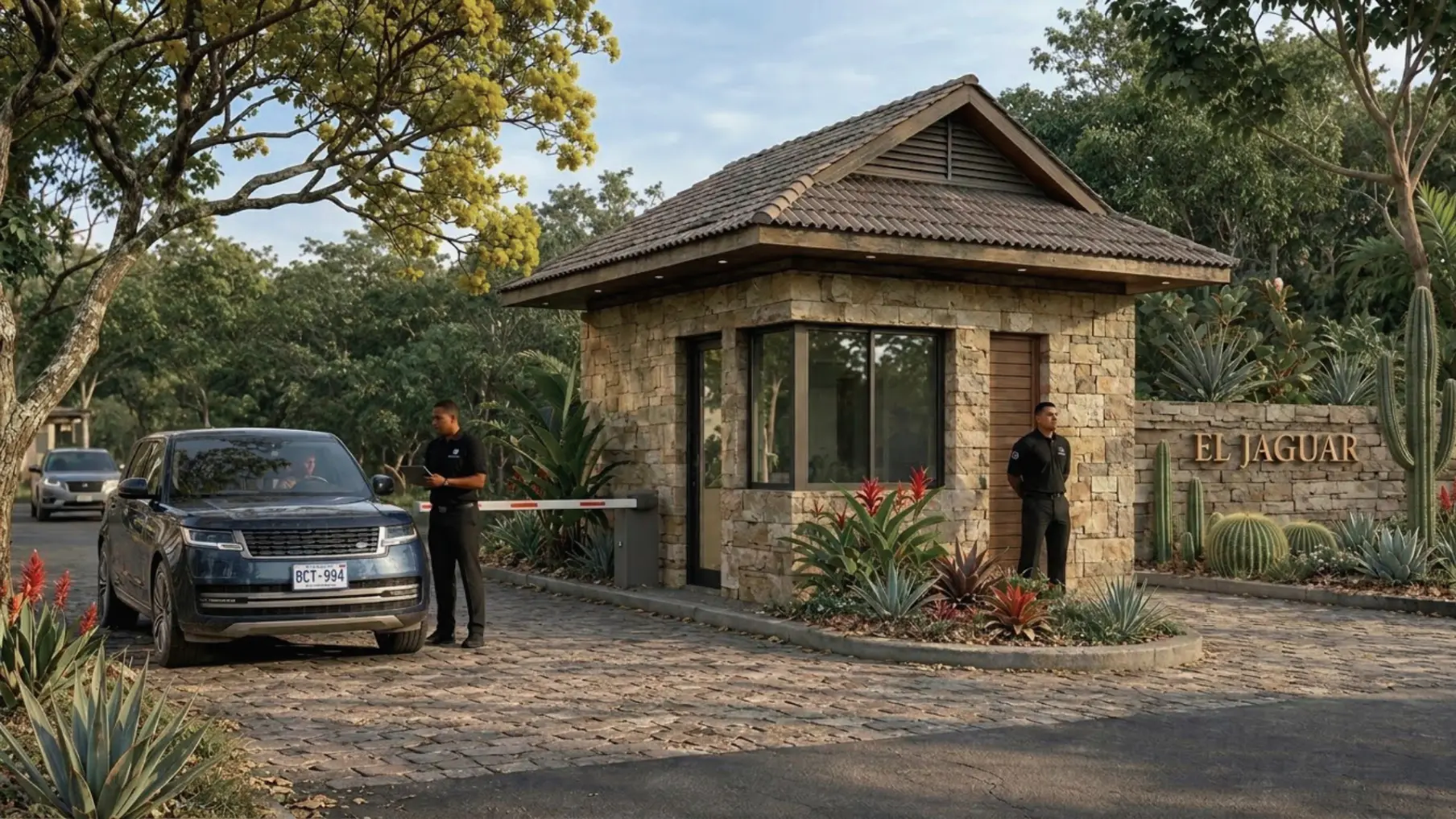
El Jaguar is a private gated community of 54 homesites within Hacienda Pinilla, in Santa Cruz, Guanacaste. Owners buy a lot and build their own home, so most of the line items above are shaped by decisions you make during design. The community’s guidelines, such as a maximum of two levels, a 30% footprint and underground utilities, tend to favor homes that are sized with intention, and each lot has two ASADA meters. El Jaguar is a registered condominium, so owners will share common costs through a condominium fee; we do not publish a figure here, and the current budget is the right document to request. Hacienda Pinilla’s club amenities are optional and carry their own terms.
Arne answers these questions himself, Monday to Friday.
Common misconceptions
“Property tax in Costa Rica is so low it barely matters.”
The 0.25% municipal rate is low, but a higher-value home may also owe the Impuesto Solidario, and a company owes its own annual tax.
“The luxury-home tax applies to my lot.”
It is triggered by construction value above the yearly threshold. It becomes relevant once you build.
“My property tax is based on what I paid.”
It is based on the value registered with the municipality, which you should update at least every five years.
“Utilities are cheap here.”
Water usually is. Electricity depends heavily on air conditioning and tiered tariffs.
“My dollar budget is fixed.”
Many costs are in colones. When the colón strengthens, your dollar costs rise.
“HOA fees stay where they start.”
Fees can change when owners take over the budget from the developer.
What to verify before you buy
Frequently asked
What is the property tax rate in Costa Rica?
The municipal property tax is 0.25% per year of the property’s registered value, under Ley 7509.
What is the luxury-home tax threshold for 2026?
¢143,000,000 of construction value, set by Executive Decree 45358-H. Above that, land and construction are taxed at marginal rates from 0.25% to 0.55%.
When are the annual taxes due?
For 2026, the Impuesto Solidario was due January 15 and the corporate tax January 31. Municipal tax schedules vary by municipality.
How much does a company that holds my house pay each year?
For 2026, between ¢69,330 and ¢231,100 depending on its tax registration and income. An inactive holding company typically pays ¢115,550.
Does a stronger colón raise my costs?
In dollar terms, yes, for every bill priced in colones. Between January and August 2026, the colón strengthened by about 9.6%.
Are HOA fees the same everywhere?
No. They depend on services, community size and the reserve plan. Ask for the approved budget.
Is a golf or beach club membership part of ownership costs?
Only if you choose one. At Hacienda Pinilla, club access is optional and has its own terms.
#### Sources
See the source list below (Sources and unresolved checks).
This article is general information, not tax or legal advice. Confirm current rates and your obligations with a Costa Rican attorney or accountant.
Sources
- EY, “Costa Rica: Impuesto Solidario, tramos y monto exento actualizados para 2026” (Decree 45358-H, La Gaceta Alcance 164, Dec 19, 2025)
- AG Legal, “Impuesto Solidario a las casas de lujo: guía y calculadora” (land added above threshold; form D-174; Jan 15, 2026 deadline), Apr 14, 2026
- EY, “Costa Rica: vencimiento plazo para pagar el impuesto a las personas jurídicas, período 2026” (base salary ¢462,200; amounts; Jan 31 deadline)
- Siempre al Día, “Impuesto sobre bienes inmuebles en Costa Rica (Ley 7509): guía 2026” (0.25%, five-year declaration, payment schedules)
- El Observador, “Dólar cae a ¢449,17 en Monex y marca nuevo mínimo”, Aug 13, 2026 (BCCR Monex data)
- Tico Times, “Costa Rica’s strong colón is forcing central bank action”, Feb 21, 2026
- El Mundo CR, “El colón se aprecia aceleradamente en 2026”, Feb 26, 2026
- El Mundo CR, “ARESEP fija rebaja en tarifas eléctricas para el 2026”, Dec 12, 2025
- El Observador, “Nuevas tarifas de agua en Costa Rica”, Mar 21, 2025
- La República, “INS ofrece seguro para propietarios y arrendatarios de viviendas” (Seguro Hogar Comprensivo), Feb 29, 2024
- Coldwell Banker Costa Rica, “The real costs of owning property in Guanacaste”, Jun 26, 2026 (market estimate: HOA, utilities)
- Tico Times Real Estate, “Understanding HOA fees in new developments”, Jul 25, 2021
- KRAIN Costa Rica, “HOA expenses in Costa Rica”, modified Sep 20, 2022
- Nest Stays, “Property management fees in Costa Rica”, Feb 21, 2026 (market estimate)

Written by
Arne
Co-developer of El Jaguar, living in Guanacaste. He’ll personally get back to you.
Monday to Friday, 8:00 am to 6:00 pm Saturday, 9:00 am–1:00 pm (Costa Rica time).
